
Hinges do more than most people give them credit for. They're what keep gates, doors, machinery guards, and other structures moving smoothly day after day. In heavy-duty applications especially, weld-on hinges tend to win out over standard hinges, and it's not hard to see why. Greater strength, better security, and durability that actually holds up over the long run.
Heavy-duty weld-on hinges are manufactured from stainless steel or carbon steel. That's what makes them such a reliable fit for industrial facilities, commercial properties, security gates, agricultural entrances, and equipment enclosures. Get the installation right, and these hinges will carry substantial loads without skipping a beat year after year.
This guide walks through the most common types of weld-on hinges and breaks down exactly how to weld hinges on metal gates the correct way.
Best Heavy-Duty Gate Hinges for Welded Gate Applications
Not every hinge works for every job. Several types of heavy duty gate hinges are regularly used depending on what the application actually demands.
This includes barrel hinges, mortise hinges, butt hinges, ball bearing hinges, and pivot hinges, each suited to different gate weights, swing requirements, and mounting styles.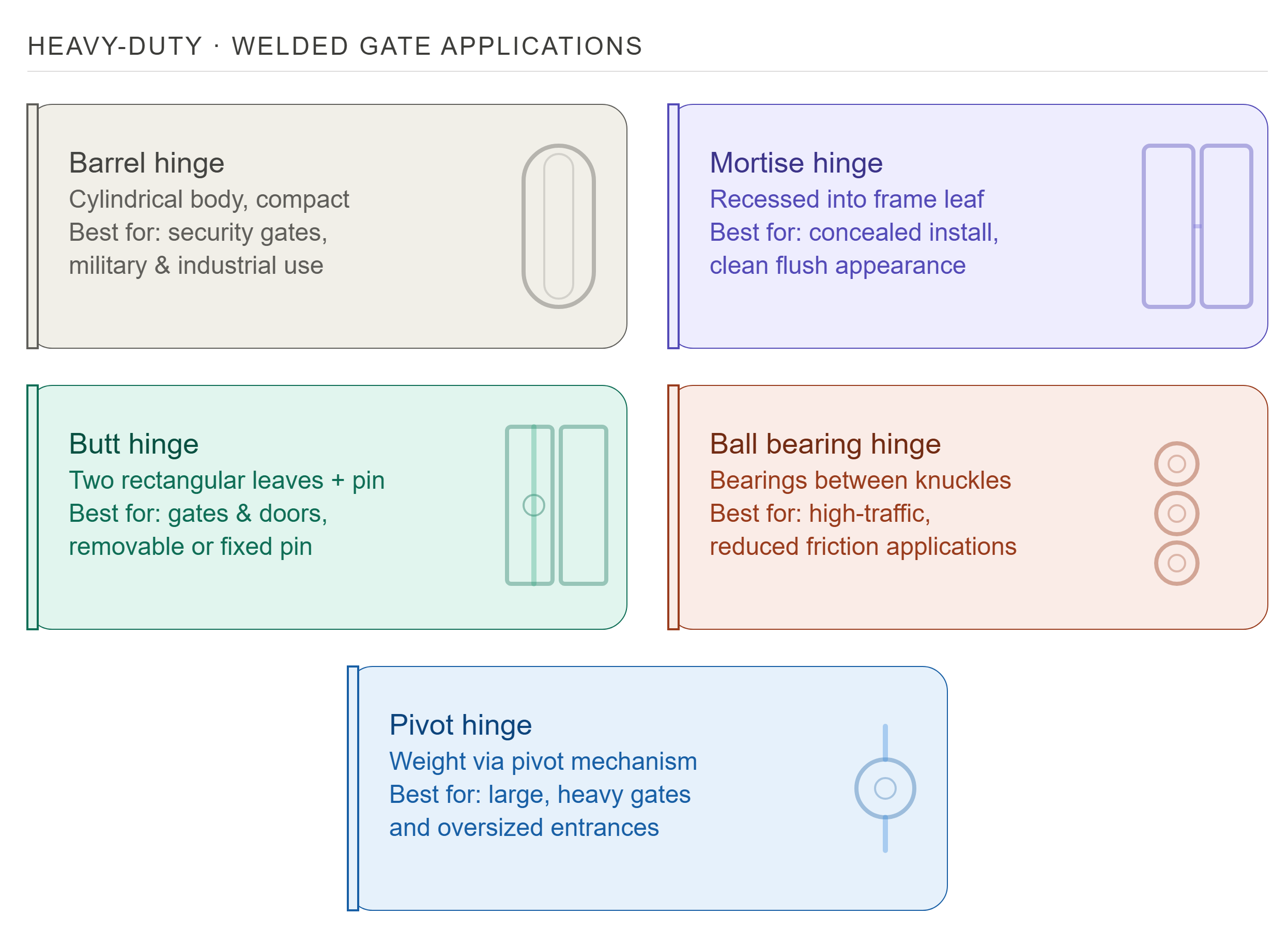
 Finding the Right Heavy-Duty Gate Hinge for Your Application
Before you purchase any hinges, get the hinge selection right. These are the factors that matter most:
- Gate weight and dimensions
- Required radial load
- Style of hinge
For industrial and commercial settings, heavy-duty industrial hinges are usually the smarter call. They are built to handle continuous operation and conditions that would wear out a lesser hinge fast.
How to Weld Hinges on Metal Gates
Before anything else, make sure you've got everything on hand:
- Metal gate or door
- Heavy-duty weld-on hinges
- Welding machine
- Welding helmet, gloves, and protective clothing
- Clamps and locking pliers
- Measuring tape and marker
- Angle grinder with cutting and grinding discs
Follow these steps for proper installation
1) A minimum of 2 hinges (1 pair) are used per door.
2) Door weight or thrust load shall not exceed the thrust capacity of one hinge.
3) Ensure proper radial loading is not exceeded.
4) For bolt-on applications - Minimum thread engagement into the reinforcing members shall be equal to or greater than the bolt diameter.
5) For weld-on applications, the minimum fillet weld size shall be as shown below and be full length on three sides of each leaf:
**1/4" Fillet weld on 2500, 2875, 2100, 1000, and 2000 **
**1/2" Fillet weld on 2125, 2150 and 2200 **
**3/4" Fillet weld on 2250**
**1 1/4" Fillet weld on 3000**
Under no circumstances should the barrel be welded on.
6) Temperature at the hinge barrel shall not exceed 220°F (105°C) during the welding process.
7) The hinges are installed without binding of the hinges.
8) Adequate load distribution between hinges is necessary to obtain the longest hinge life and highest safety level.
9) Maximum height adjustment is 1/8".
Precautions When Working with Heavy Duty Weld-On Gate Hinges
To ensure safe installation and long-term performance:
- Always wear proper welding safety equipment.
- Use the correct welding tools and settings.
- Perform welding in a well-ventilated area.
- Clear any combustible items from the area before you start welding.
- Inspect hinge alignment throughout the installation process.
Frequently Asked Questions
Are weld-on hinges stronger than bolt-on hinges?
In most heavy-duty applications, yes, and it's not really a close contest. Weld-on hinges become part of the gate structure itself, which is exactly what gives them that edge in strength and security that bolt-on options simply can't match. But bolt-on hinges give you the best option for future replacement or adjustment.
What is the best welding method for gate hinges?
MIG or stick welding is the go-to for steel gate hinges. It is reliable and efficient. TIG welding is also used when a cleaner, more precise weld is needed, particularly for stainless steel hinges.
Can weld-on hinges be used outdoors?
Absolutely. Properly coated steel hinges and stainless-steel hinges handle outdoor environments without any problems. Rain, dust, temperature swings, etc.
Need High-Quality Weld-On Hinges?
Kiesler Machine builds heavy-duty weld-on hinges, gate hinges, and custom industrial hinge solutions for applications. Extensive inventory, fast turnaround times, and real custom manufacturing capability. It all adds up to finding the right hinge for your specific job, not just a close enough one.
Ready to get started? Contact the team at Kiesler Machine today to talk through your project or request a quote.
Share this: